Loading page
What happens to skin between thirty and fifty
Bone, fat, dermis and muscle change on four different timetables, and only some of it responds to treatment. What is actually happening between thirty and fifty, and the order in which it is worth addressing.

Narges, Founder & Medical Director
6 min read
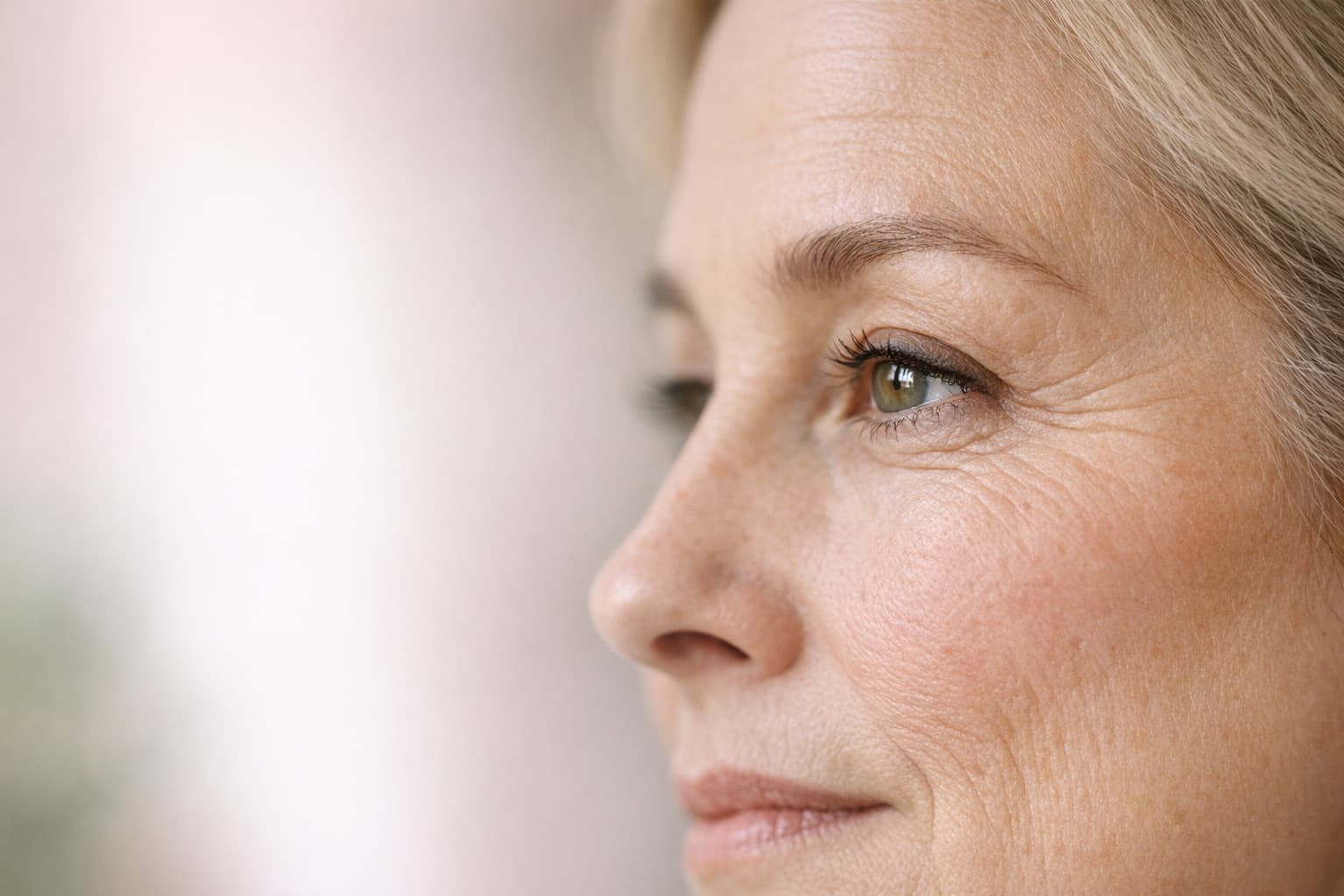
Somewhere in this range most people stop recognising the face they had at twenty-five, and they describe it with a single word — tired, heavier, less defined. It is never a single thing. Four or five separate processes are running at once, on different timetables, and they are not equally treatable. Knowing which is which is the difference between spending money usefully and spending it repeatedly.
The bone moves first, and it moves away
The skull is not a fixed frame. Imaging studies that follow the same faces over years find the orbital aperture widening, particularly at the upper outer and lower inner rims; the maxilla rotating backwards and losing projection; the angle of the mandible opening. The changes are small in millimetres and large in effect, because everything soft is draped over them. A cheek that appears to have fallen has often lost the shelf it was resting on.
Nothing topical touches this. It is the one part of facial ageing that is genuinely structural, and it is why a face at forty-five can be at a stable weight, well slept and diligently looked after, and still read as flatter through the midface than it did at thirty.
The fat pads deflate, and separately, they descend
Facial fat is not one layer. It sits in discrete compartments, superficial and deep, separated by fibrous septa, and they do not age together. The deep medial cheek fat and the fat behind the nasolabial fold tend to lose volume early. The superficial compartments lower down tend to keep their volume but sit lower than they did. The boundary between a deflated compartment above and a full one below is exactly what a person is looking at when they point at a nasolabial fold and ask for that line to be gone.
The line is a consequence, not the problem. Filling it directly is the single commonest way to make a face look heavier while technically improving the photograph.
The dermis thins, and the reason is mostly light
You will read that collagen falls by about one per cent a year after twenty-five. It is a useful shorthand and a weak number: it comes from small studies, it varies enormously between people, and it says nothing about quality. What is better established is the pattern. Type I collagen decreases relative to type III, the collagen bundles fragment, and elastin in sun-exposed skin degrades into a disorganised mass that no longer recoils.
From reading to treatment
Skin Treatments
The treatments this article is about, with the real duration and the price in Canadian dollars. A consultation comes first either way.
Facial
Cleanse, exfoliation, extraction and mask, adjusted to what the skin is doing that week. It maintains skin and settles congestion. It does not remodel texture or scarring — that is a course, not a facial.
1 h
Skin health5 min read
Melasma is not sun damage
One responds well to light-based treatment. The other gets worse. How to tell melasma from sun damage, why heat is the trigger nobody mentions, and what a good outcome honestly looks like.
When you are ready
Ask us in person
Reading is a good start. Forty-five minutes in the room is where we look at your face in good light, ask what you have already tried, and tell you what we actually think.
Or call (416) 834-0730