Loading page
Laser hair reduction: why we start courses in the autumn
Tanned skin and hair-removal lasers compete for the same light. Why we start most courses in October, and what to do in the four weeks before your first session.
L
Leila, Laser Technician
6 min read
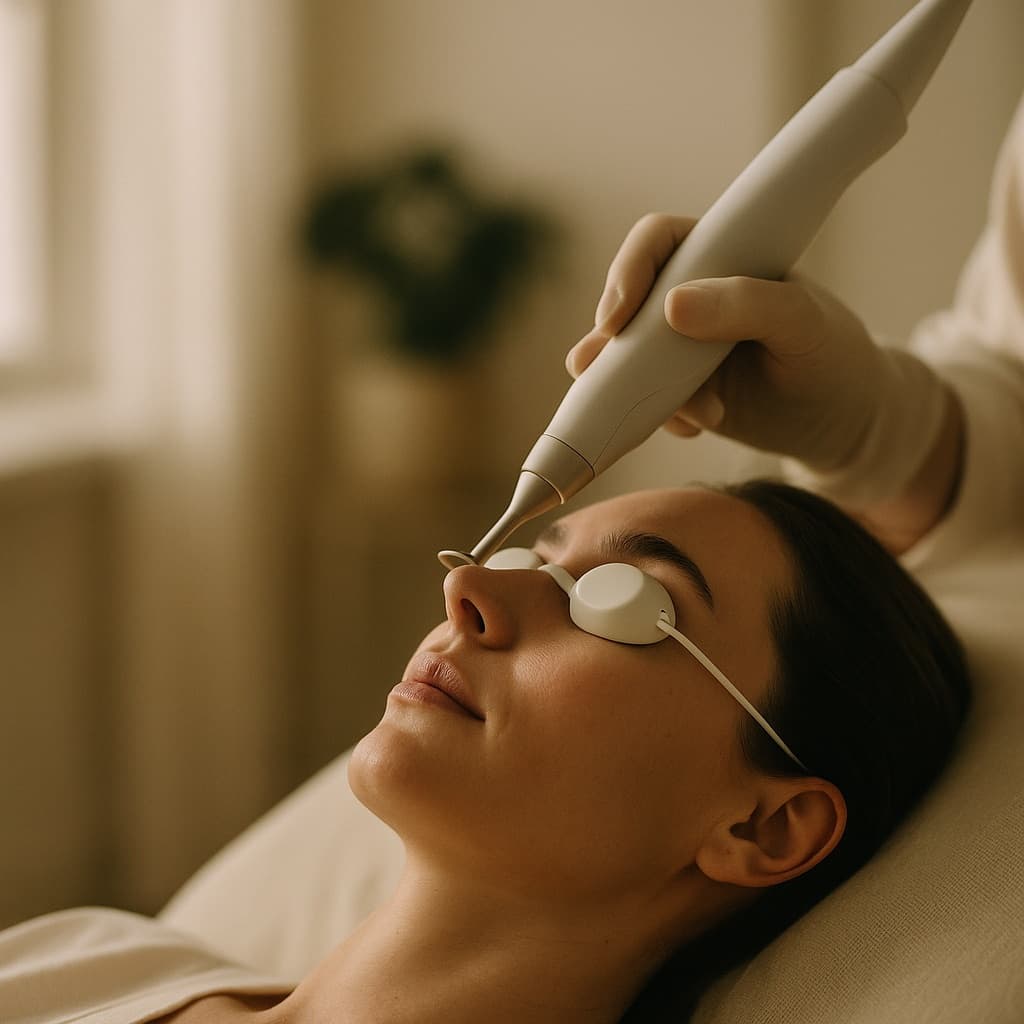
Almost every laser hair reduction course we start between October and March goes better than the ones that start in June. The reason is not scheduling convenience; it is that the treatment and a Toronto summer are in direct conflict.
A hair-removal laser works by finding pigment. Light is absorbed by melanin in the hair shaft, converted to heat, and that heat damages the follicle. The problem is that melanin in the surrounding skin absorbs the same light. The greater the contrast between hair and skin, the more energy can be delivered to the follicle safely. A recent tan — including a self-tan, which sits in the skin optically much like the real thing — reduces that contrast and raises the risk of blistering and of pigment changes that outlast the hair.
So the rule is simple: no sun exposure and no self-tanner for two weeks before and two weeks after each session, and broad-spectrum SPF 50 on any treated area that will see daylight. In January that is easy to follow. In July, on a patio, it is not.
A full course is six to eight sessions, spaced four to six weeks apart on the face and six to ten weeks on the body. That is six to twelve months of appointments. Starting in October means the bulk of the course happens while you are wearing sleeves.
The spacing is not arbitrary either. Hair grows in cycles, and only follicles in the active anagen phase are vulnerable. At any moment only a portion of the hair in an area is in that phase, which is why one session cannot clear everything, and why coming back too soon wastes a session on follicles that are not yet targetable.

Preparation on the day is straightforward. Shave the area twelve to twenty-four hours before — the laser needs the follicle intact below the surface and the shaft gone from above it. Anything that removes the root, so waxing, threading, plucking and epilating, must stop four weeks before your first session and stay stopped for the whole course. Come without deodorant, makeup or lotion on the treated area. Tell us about any new medication; several common ones, including some antibiotics and acne treatments, increase photosensitivity, and isotretinoin requires a waiting period after you finish it.
We use a Candela GentleMax Pro, and choosing between its two wavelengths is most of the skill. The 755 nm alexandrite is strongly absorbed by melanin and efficient on lighter skin with dark hair. The 1064 nm Nd:YAG penetrates deeper and is absorbed far less by epidermal melanin, which makes it the appropriate and safe choice for Fitzpatrick IV to VI. Both deliver a cryogen cooling burst milliseconds before each pulse. A patch test at consultation confirms settings before we treat a full area.
From reading to treatment
Laser Hair Removal — Women
The treatments this article is about, with the real duration and the price in Canadian dollars. A consultation comes first either way.
Laser Hair Removal — Upper Lip
Laser hair removal on the Candela GentleMax Pro, wavelength matched to your skin tone. Shave the area the day before; no waxing, plucking or sun for the weeks around each session. Most people need a course of sessions spaced to the hair's growth cycle.
10 min
Laser5 min read
What a laser course actually involves
Six sessions is not the plan; the spacing is. Patch tests, growth cycles, wavelength by skin type, the real downtime for each kind of treatment, and the list of people who should wait.
When you are ready
Ask us in person
Reading is a good start. Forty-five minutes in the room is where we look at your face in good light, ask what you have already tried, and tell you what we actually think.
Or call (416) 834-0730